SEO has changed.
For a long time, the goal was obvious: get onto page one of Google, stay there, and hope the traffic follows. But Google AI Overviews have opened a completely different path. You can now get cited at the very top of search results without having a giant site, without waiting years, and without even ranking on page one.
That sounds exaggerated until you look at the data. In a large study covering 863,000 searches and 4 million AI Overview citations, only 38% of the pages quoted by Google’s AI were also ranking on page one. That means most of the pages being pulled into AI answers were not traditional top 10 winners.
That is the opportunity.
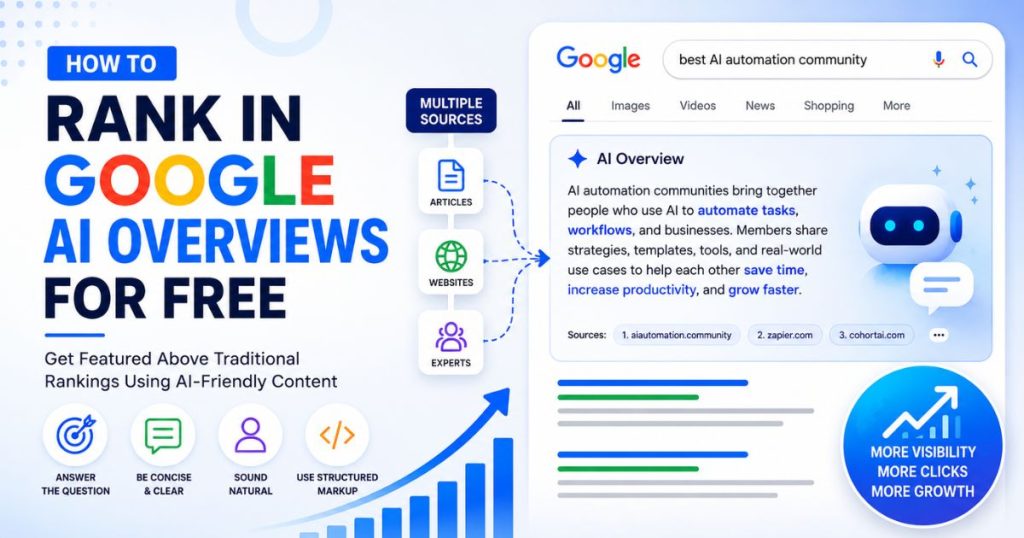
If you understand how Google AI Overviews build answers, you can create content specifically for that system and give yourself a real shot at being featured for free.
Why Google AI Overviews changed the SEO game
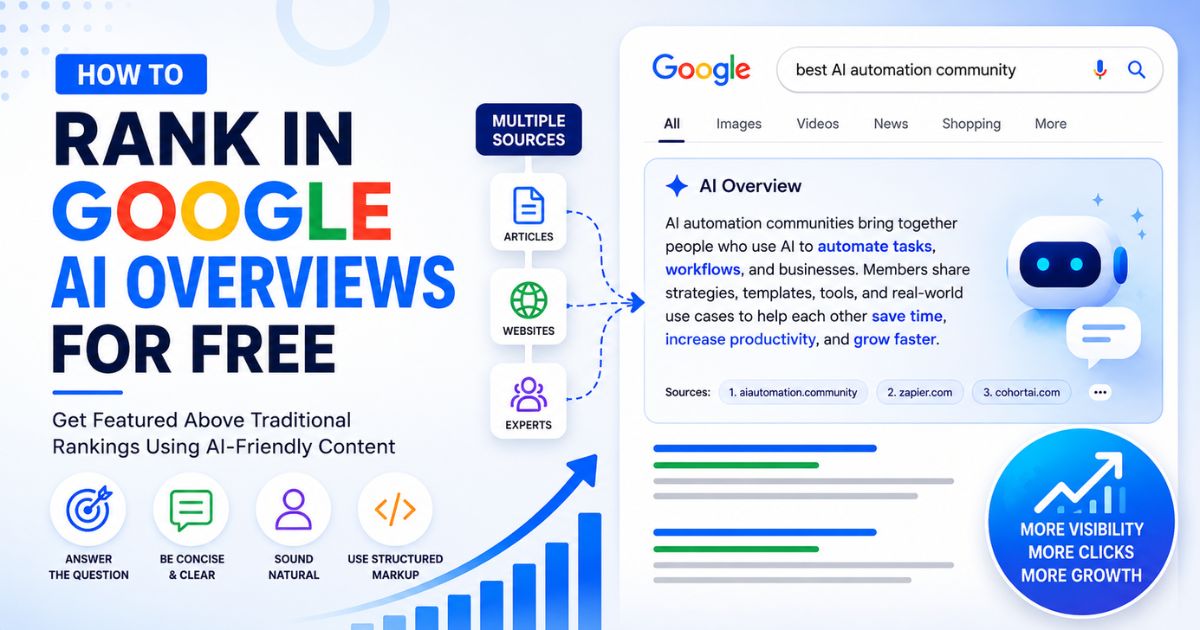
When someone searches in Google now, they often see a generated answer box before the normal blue links. Under that answer are source links. Those are the pages Google’s AI chose to rely on.
Most people still assume Google picks one big authority site and summarizes it. That is not how this works.
Google’s AI breaks a search into smaller subquestions, finds the clearest answer for each one, and then combines them into a single response. If your page answers one of those smaller questions better than everyone else, you can be cited even if your site is smaller and even if you are nowhere near page one.
This is the key idea: you do not need to own the whole topic. You need to answer a useful slice of it clearly.
The one concept you need to understand: fan out
The simplest way to think about AI Overviews is this: one search becomes many hidden searches.
Google takes the original query and quietly expands it into related questions. Then it hunts for concise, trustworthy answers to each of those mini-questions.
For example, imagine someone searches for best AI automation community.
Google’s AI may also try to answer questions like:
- What is an AI automation community?
- What do members get inside one?
- Is it useful for a small business?
- Who is it for?
- Is it beginner friendly?
Every one of those questions is a separate opportunity.
If your page gives a strong answer to even one of them, Google may use your page as part of the final AI Overview. That is why smaller sites suddenly have a chance. The system is not only rewarding broad authority. It is also rewarding specificity and clarity.
What Google’s AI wants from your content
If you want to rank in Google AI Overviews, your content has to be easy for AI systems to extract and reuse. That means:
- Answer first
- Keep it concise
- Sound human
- Cover related subquestions
- Use structured markup like FAQ schema
Most content fails because it takes too long to get to the point. It opens with filler, broad context, and generic introductions. AI Overviews do not want a long warmup. They want the cleanest possible answer near the top of the page.
Step 1: Answer the question immediately
The first line matters.
If the page is trying to answer a question, put the answer right at the top in plain language. Think definition first, explanation second.
A good prompt for AI writing tools is something like this:
- Write a 50-word answer to the question.
- Start with a clear definition.
That format works because it forces directness. It removes the fluff and gives Google exactly what it wants to quote.
If your content begins with a clean, simple answer, you immediately make it easier for Google’s AI to understand what the page contributes.
Step 2: Keep the main answer tight
Long, wandering explanations make extraction harder.
The goal is not to stuff a page with as many words as possible. The goal is to make the answer easy to lift and reuse. A concise answer around 150 words is often a much better fit than 600 words of rambling.
That does not mean your whole page has to be short. It means the core answer should be tight and easy to quote.
When refining content, focus on:
- Removing repetition
- Cutting vague language
- Using plain English
- Keeping each sentence useful
Concise content is not just easier for people to read. It is easier for AI systems to process.
Step 3: Make it sound natural, not robotic
Clarity matters, but so does tone.
Stiff, corporate copy often sounds unnatural and over-optimized. Google’s AI tends to favor content that feels clear and human. If a response reads like something you would actually say in conversation, it is usually stronger than something bloated with jargon.
One simple content editing principle is this: explain the idea the same way you would explain it to a smart friend over coffee.
The facts stay the same. The delivery gets warmer, simpler, and easier to digest.
That kind of writing tends to be more quotable because it feels immediate and understandable.
Step 4: Build pages around the full question cluster
This is where most people stop too early.
They create one page targeting one keyword and wonder why nothing happens. But Google AI Overviews are built from clusters of related questions, so your page should be built that way too.
Instead of focusing on a single headline term, map out all the questions surrounding the topic and answer them directly on the page.
For a topic like AI automation communities, that might include:
- What is an AI automation community?
- How does an AI automation community help a small business?
- What do members get access to?
- Is it suitable for beginners?
- Who benefits most from joining?
- How is it different from a course or mastermind?
Each question becomes a subheading. Under each subheading, place a short, useful answer.
Now your page is not relying on one keyword. It becomes a resource that satisfies multiple parts of the fan out process at once.
That is how a smaller site can outperform a larger one. It can be more precise.
Find the questions competitors forgot
Content gaps are where the easiest wins live.
If every competitor answers the obvious questions, but nobody addresses a specific concern like whether a product or community is beginner friendly, that missing answer becomes a chance to own that slice of the topic.
These overlooked subquestions are valuable because:
- Competition is lower
- The answer is easier to stand out with
- Google still needs content to fill that gap
When Google’s AI cannot find a good answer from established pages, a smaller page with a better response can get pulled in.
This is why the strategy works so well. You are not trying to beat every competitor at everything. You are looking for the empty seats and taking them.
Step 5: Add FAQ schema so Google can read it properly
Schema is one of those technical SEO topics that scares people off for no good reason.
At its core, schema is just structured code that helps search engines understand what is on the page. FAQ schema is especially useful here because it clearly labels questions and answers.
That sends a strong signal to Google:
- This is a question
- This is the answer
- Here is the structure
For AI Overviews, that kind of clarity helps.
You do not need to hand-code it if you do not want to. You can generate FAQ schema with AI, paste it into your page, and move on.
The important thing is not whether you personally write the code. The important thing is that the page is structured in a machine-readable way.
Step 6: Publish, track, and learn from what gets cited
Once the page is live, the work is not over. You need to monitor performance and see what Google is actually pulling into AI answers.
Google has introduced reporting that helps reveal how often pages appear inside these AI-driven results. That means this is no longer a blind process. You can start spotting patterns in what is working.
Pay attention to pages that get cited and ask:
- How was the answer structured?
- How quickly did it get to the point?
- Which subquestions did it cover?
- Was the tone more natural or more formal?
- Did the page use FAQ schema?
When you find a winner, do not treat it as luck. Treat it as a template.
Build more pages using the same shape, the same level of clarity, and the same question-cluster logic. That is how the strategy compounds.
Why this can snowball quickly
The old SEO model was slow and brutal. You would chase competitive keywords, build links for months, and hope to crack page one.
The AI Overview model is different.
You publish targeted pages that answer smaller questions clearly. Google picks up the best fragments. Then you study which fragments get quoted and create more like them.
That creates a feedback loop:
- Publish concise, structured answers
- Track which pages get cited in AI Overviews
- Identify patterns in successful pages
- Create more pages using those patterns
Over time, this gives you a repeatable process instead of random content production.
YouTube is also becoming a major citation source
There is another important angle here. YouTube is now one of the most cited sources in AI Overviews, and its visibility has grown sharply over a short period.
That means video content can support this strategy too.
If you are already creating videos around your niche, those assets may become citation sources for Google’s AI answers. In other words, your written content and your YouTube content can both contribute to visibility in AI search.
This matters because AI search is no longer just a website game. It is a content clarity game across formats.
A simple framework for ranking in Google AI Overviews
If you want the entire strategy boiled down, it looks like this:
- Choose a search topic
- Break it into smaller related questions
- Answer each question clearly and quickly
- Keep each answer concise and human
- Add FAQ schema
- Publish the page
- Track whether it appears in AI Overviews
- Repeat what works
That is the system.
It is simpler than traditional SEO in some ways because it rewards precision over size. You are not trying to become the biggest site on the internet. You are trying to become the clearest answer to the right subquestion.
The big opportunity right now
Remember the number: 38%.
That means more than half of the pages Google’s AI cites are not on page one. For anyone with a smaller site, that is a massive opening.
You do not need to wait until your domain is stronger. You do not need to beat every giant in your space across broad head terms. You need to create pages that answer the hidden subquestions better than the pages already out there.
That is what makes Google AI Overviews such an interesting opportunity right now. The door is open, and it is open wider than most people realize.
Final takeaway
The old playbook was simple but painful: chase rankings, wait, and hope.
The new playbook is smarter. Answer small questions clearly, structure the page so Google can read it, publish it, and let AI Overviews do the distribution.
If your content is direct, useful, and easy to extract, you have a real chance to get featured at the top of Google for free, even without page one rankings.
That is the shift. And the people who act on it early have the best chance to win.