If you run a service-based business—such as plumbing, HVAC, roofing, electrical work, cleaning services, healthcare, or any other local service—Local SEO is no longer optional. It has become one of the most reliable and cost-effective ways to attract high-intent customers directly from Google.
Search behavior has changed dramatically. Instead of typing broad keywords, people now search with location and urgency:
“plumber near me”
“AC repair in [city]”
“Emergency electrician open now.”
These searches come from users who are ready to call, book, or visit, not just browse.
In this guide, you’ll learn how Local SEO works in 2026, why Google prioritizes it, and how to use it to generate consistent calls, messages, and leads for your service business.
What Is Local SEO?
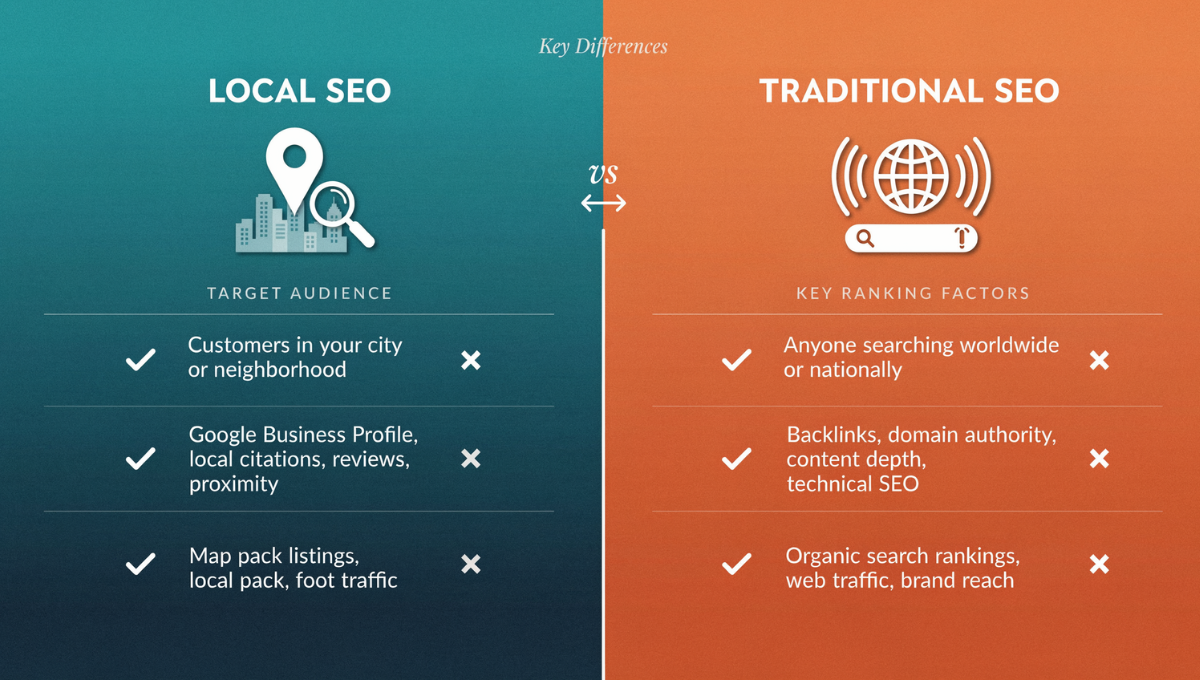
Local SEO is the process of optimizing your online presence so your business appears when people search for services within your geographic area.
Local SEO primarily impacts three parts of Google:
Google Map Pack (Top 3 map results)
Local organic search results
Google Business Profile actions (calls, directions, messages)
For service businesses, Local SEO means:
When someone in your city needs your service, Google confidently recommends your business first.
This recommendation is based on relevance, proximity, and trust—not just keywords.
Why Local SEO Is So Powerful for Service Businesses
Local SEO is effective because it targets buyer intent, not just vanity traffic.
Here’s why it consistently outperforms generic SEO:
Over 70% of “near me” searches result in action within 24–48 hours
Calls from Google Maps convert significantly higher than website form submissions
Paid ads stop the moment budgets pause, but Local SEO builds long-term visibility and trust
From real-world Local SEO campaigns, one pattern is consistent:
Businesses that dominate local search receive fewer price shoppers and more ready-to-buy leads.
That’s why plumbers, roofers, HVAC companies, doctors, dentists, lawyers, and contractors rely heavily on Local SEO for sustainable growth.
Core Pillars of Local SEO
1️⃣ Google Business Profile Optimization (Most Important)
Your Google Business Profile (GBP) is the foundation of Local SEO.
Google uses it as the primary data source to evaluate local relevance and legitimacy.
To rank consistently, you must:
Use the correct business name, address, and phone number (NAP)
Select the right primary category (this alone can change rankings)
Define accurate service areas
Write a keyword-focused but natural business description
Upload real photos (location, team, work in progress)
Publish weekly updates (offers, tips, announcements)
⚠️ From experience, one of the fastest ranking improvements often comes from fixing incorrect categories and inactive profiles.
2️⃣ Online Reviews: Trust + Ranking Signal
In 2026, reviews are not just social proof—they are a direct ranking factor.
An effective review strategy includes:
Consistent review acquisition (not bulk requests)
Natural service mentions within reviews
Responding to every review, positive or negative
Handling negative feedback professionally and transparently
Key takeaway:
A profile with fresh reviews and active owner responses sends strong trust and engagement signals to Google.
3️⃣ Website Optimization for Local Services
Many businesses assume having a website is enough—but ranking data shows otherwise.
Common issues:
One page trying to rank for every service
No clear city or service targeting
Weak or unclear calls-to-action
Your website should include:
Separate, well-optimized service pages
Clear city and service coverage
Fast loading speed (especially on mobile)
Click-to-call buttons
Local business schema markup
Google favors businesses where the website and Google Business Profile reinforce each other with consistent information.
4️⃣ Location Pages That Actually Rank
If you serve multiple cities, avoid duplicating content across pages.
High-performing location pages include:
City-specific introductions
Local problems your service solves
Nearby landmarks or neighborhoods
Unique FAQs for each location
Testimonials or real examples when available
This structure helps Google understand that your business is genuinely relevant, not just technically optimized.
5️⃣ Local Citations & NAP Consistency
Citations are mentions of your business across:
Online directories
Local listings
Industry-specific platforms
Best practices:
Keep NAP details identical everywhere
Remove duplicate or outdated listings
Prioritize quality and relevance over volume
While citations may seem minor, they play a crucial role in reinforcing trust across the local ecosystem.
How AI Search Is Changing Local SEO in 2026
Google no longer relies solely on keyword matching. AI-driven search evaluates context, credibility, and real-world validation.
What matters more now:
Real photos and visible business activity
Consistent brand and contact information
Clear explanations of services
Helpful, human-written content
Shortcuts and artificial signals no longer work.
Key takeaway:
Consistency + authenticity are now core ranking drivers.
Common Local SEO Mistakes That Kill Rankings
Avoid these common issues:
Keyword stuffing across pages
Choosing the wrong Google Business Profile category
Ignoring or manipulating reviews
Thin, generic service pages
Inconsistent phone numbers or addresses
Not tracking calls and conversions
Even a single mistake can reduce visibility across Google Maps and local search.
How Long Does Local SEO Take to Show Results?
Realistic timelines based on active campaigns:
Month 1: Setup and foundational optimization
Month 2–3: Visibility and map impressions improve
Month 3–6: Increase in calls and inbound leads
Month 6+: Stable rankings and compounding ROI
Local SEO is not a shortcut—but it builds long-term, defensible growth.
Local SEO vs Paid Ads: Which Is Better?
| Feature | Local SEO | Paid Ads |
|---|---|---|
| Long-term ROI | High | Low |
| Trust factor | High | Medium |
| Cost over time | Decreases | Increases |
| Map visibility | Strong | Limited |
The most successful service businesses use ads for speed and Local SEO as their long-term growth engine.
Local SEO Is a Growth Engine
Local SEO is not just about rankings—it directly impacts:
More phone calls
More booked appointments
More walk-ins
More predictable revenue
If you want to:
Reduce dependence on paid ads
Generate inbound leads consistently
Become the most trusted service provider in your area
Then, Local SEO should be a top priority in 2026.
Want More Local Calls & Leads?
We help service businesses dominate Google Maps with proven Local SEO strategies.Not sure why your business isn’t ranking on Google Maps?
Get a free Local SEO audit and discover what’s holding your visibility back.