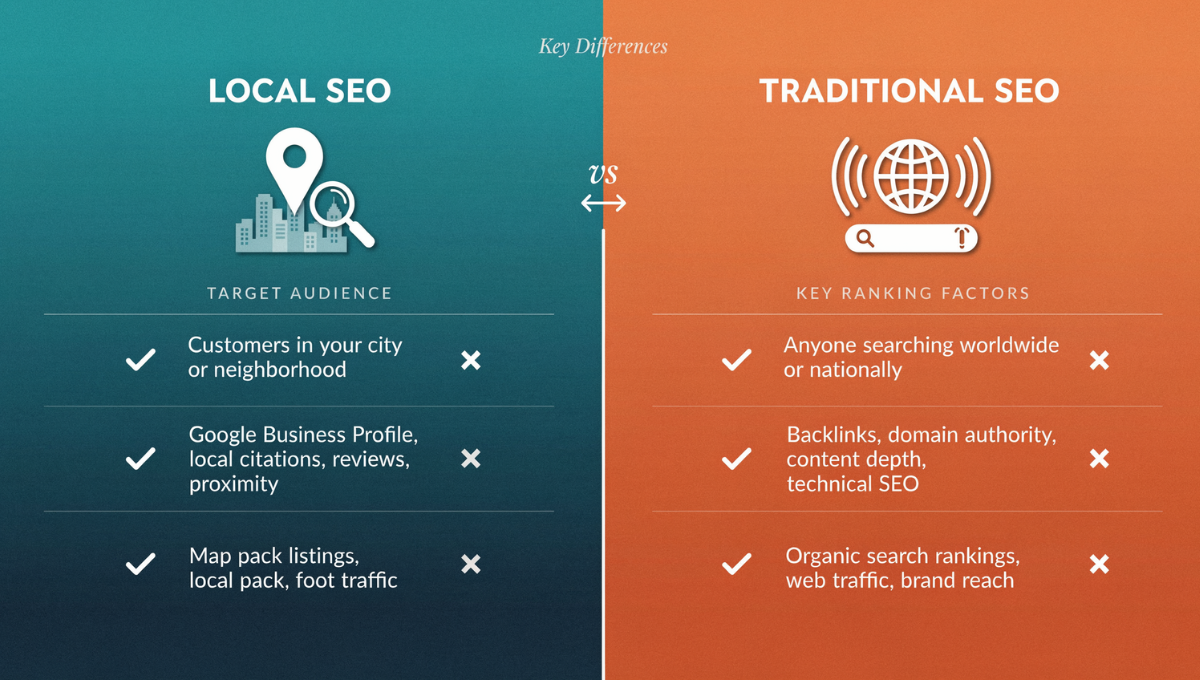
To rank in the Google Map Pack, a business needs a complete and verified Google Business Profile, an accurate primary category, genuine customer reviews, consistent NAP information across the web, local backlinks, and a fast, mobile-friendly website. Google ranks local results using three factors: relevance, distance, and prominence.
Google Business Profile is the entity that connects a business to Google Search and Google Maps. Relevance measures how well a business matches a search query. Distance measures how close a business is to the searcher. Prominence measures how well-known and trusted a business is. A business improves its Map Pack ranking by strengthening relevance and prominence, since distance cannot be controlled directly.
| Factor | Definition | Primary levers |
|---|---|---|
| Relevance | Match between business and search query | Category, services, business description, website content |
| Distance | Physical proximity to the searcher | Accurate address and service-area settings |
| Prominence | Business reputation and authority | Reviews, backlinks, citations, local media coverage, profile activity |
13 steps to rank in Google Map Pack as below:
1. Create, Verify, and Complete Google Business Profile
Google Business Profile is the core entity Google uses to represent a business in local search results. A verified profile ranks higher than an unverified one, because verification confirms the business is real and active at its stated location.
A business owner sets up Google Business Profile with the real business name, the real address or service area, and a working phone number. Google verifies the business through postcard, phone, email, or video, depending on the business type and location.
After verification, the business owner completes every profile field:
- Primary category and secondary categories
- Services and products
- Business description
- Attributes
- Regular hours and special hours
- Booking or appointment links
- Photos and videos
Each field should state a fact about the business, not a keyword. Google Business Profile data must match the business website. A mismatch between the profile and the website (wrong hours, wrong phone number) weakens the business’s local ranking signal.
2. Choose the Most Specific Primary Category
Primary category tells Google what type of business an entity is. Google weighs primary category heavily in local ranking, often more than business owners expect.
A business owner should choose the most specific category available, not the broadest one. ABC Dental Clinic is a Dentist. Its services are dental implants, teeth cleaning, and root canal treatment. Category defines the business type. Services define what the business does.
A business owner adds secondary categories only when those categories describe real parts of the business. A business should not copy a competitor’s category choice without matching that category to its own actual services.
3. Build Local Relevance Through Services and Content
Local relevance is the match between a search query and a business’s actual services and location. A search for “emergency plumber in Dhaka” requires evidence linking Plumber, Emergency Plumbing, and Dhaka to one business.
A business builds this evidence through its Google Business Profile, its services list, its website content, and its customer reviews. Repeating one keyword many times does not build relevance. Listing real, specific services builds relevance.
An HVAC company lists AC repair, AC installation, furnace repair, and heat pump installation as separate services. Each service is a distinct entity connected to the business. A strong local profile states three facts clearly: what the business does, where it operates, and who it serves.
4. Optimize Website Content and Page Speed
A business website must state the same facts as its Google Business Profile: business name, services, location, and contact information. A mismatch between website content and profile content weakens local ranking signals.
A business creates a dedicated page for each major service. A plumbing company creates separate pages for Emergency Plumbing, Drain Cleaning, and Water Heater Repair. A business creates a separate page for each real service location. A page that only swaps the city name provides no unique value and can hurt rankings.
A website connects its pages through internal links: homepage to service pages, service pages to location pages, location pages to supporting content.
Page speed affects both ranking and conversion. Google uses Core Web Vitals as a ranking signal, and most local searches happen on mobile devices, where slow pages cause visitors to leave before the page loads. A business improves page speed by:
- Compressing and resizing images before upload
- Using reliable hosting instead of low-cost shared hosting
- Enabling browser caching and a content delivery network
- Removing unnecessary scripts, popups, and autoplay video from key pages
- Testing the website regularly with Google PageSpeed Insights or GTmetrix and fixing flagged issues first
A slow website costs a business both rankings and customers, since a mobile visitor searching for a local service leaves quickly when a page loads slowly.
5. Keep NAP Consistent and Build Citations
NAP stands for Name, Address, and Phone number. NAP must match exactly across a business’s website, Google Business Profile, social profiles, and directory listings. A mismatched phone number on one directory creates a conflicting signal that weakens the business’s local ranking.
A business builds citations on a small number of accurate, relevant sources rather than a large number of low-quality ones:
- Citation tools: Moz Local, BrightLocal, Yext
- General directories: Yelp, Bing Places, Apple Maps, Facebook
- Industry directories: Houzz for contractors, Avvo for lawyers, Healthgrades for medical practices
- Local sources: chamber of commerce listings, local business associations
A business owner audits citations periodically, since NAP data drifts out of sync after a business moves or changes its phone number.
6. Earn Genuine Reviews and Respond to Every Review
Customer reviews are a prominence signal that Google weighs heavily in local ranking. A business earns reviews by asking real customers for honest feedback after a real purchase or service. A direct review link sent by text or email produces more reviews than a generic request.
A business should never buy reviews or request misleading reviews. Google detects manipulated review patterns and can suppress a business listing as a result.
A business responds to every review, positive and negative, with a specific reference to that customer’s actual experience. A generic, repeated response signals low engagement. A negative review response stays professional, addresses the customer’s concern, and moves further discussion to a private channel.
7. Build Local Authority Through Link Building
Local backlinks are one of the clearest prominence signals a business can earn. A single link from a relevant local organization outweighs many generic directory links.
A business earns local backlinks through several methods:
- Local sponsorships: sponsoring a youth sports team or community event earns a link from that organization’s sponsors page
- Resource page outreach: requesting inclusion on a city tourism site, neighborhood association page, or local blog’s resource list
- Guest posts: contributing a genuinely useful article to a local news site or industry publication
- Partner cross-links: requesting a link from suppliers or partners that list dealers on their own websites
- Journalist requests: responding to local reporters seeking expert quotes, which often results in a linked mention
- Chamber of commerce membership: most membership directories link to the member’s website
- Community programs: a local scholarship tied to the business name can earn links from school websites
A business avoids paid link schemes and bulk directory submissions, since Google devalues these links and can apply a manual penalty. A business prioritizes link relevance over link volume.
8. Add Real Photos and Videos
Photos and videos show customers and Google what a business actually looks like. A business uploads real photos of its storefront, interior, staff, equipment, service vehicles, and completed projects.
A business avoids stock photography, since real photos confirm the business is active and operating at its stated location. A business that uploads photos regularly tends to see higher customer engagement, and engagement itself feeds prominence.
9. Structure Multi-Location Businesses Clearly
A business with multiple locations creates a separate Google Business Profile for each real physical location. A business creates a separate website page for each location, with real, location-specific information rather than a duplicated template.
ABC HVAC is an HVAC Contractor. ABC HVAC offers AC Repair in each city it serves. Each location’s website page, Google Business Profile, and reviews should state the same facts consistently. A business’s website, profile, and citations should never contradict each other across locations.
10. Strengthen Organic SEO Alongside Local SEO
Local search visibility and organic search visibility support the same business entity. A business strengthens both by publishing search-intent-focused content, maintaining clean technical SEO, ensuring mobile usability, and earning relevant backlinks.
A business should treat local SEO and organic SEO as one connected strategy, not two separate campaigns, since the same authority signals support both.
11. Keep the Profile Active
A complete but inactive Google Business Profile loses ground to a competitor’s active profile over time. A business stays active by:
- Posting weekly updates, offers, or events through Google Posts
- Answering common customer questions in the Q&A section before customers ask
- Enabling messaging or booking and responding to inquiries promptly
Two businesses with identical review counts and profile completeness can rank differently in the Map Pack because one business stays active and the other does not.
12. Track Rankings From Multiple Locations
Distance is a core local ranking factor, so a business’s Map Pack position changes based on the searcher’s location. A business can rank first near its own address and rank seventh a few miles away.
A business tracks rankings using a grid-based tool such as Local Falcon or BrightLocal, checking multiple points across its service area rather than one search location. A business monitors ranking position alongside phone calls, direction requests, and website visits generated from its profile.
13. Analyze Competitors and Close Ranking Gaps
A business compares itself against the businesses currently ranking in the Map Pack: category choice, services listed, review count, review recency, website quality, photo activity, and backlink profile.
A business identifies specific weaknesses in its own relevance, prominence, or trust signals rather than copying a competitor’s strategy directly, then closes those gaps in order of impact.
How Long Does Google Map Pack Ranking Take?
Google Map Pack ranking improvements typically appear within two to six months, depending on competition level.
Profile and category fixes can produce early movement within two to four weeks. Review generation and citation cleanup typically show measurable change within one to three months. Backlinks and sustained local authority-building compound into stable top-three rankings within three to six months. Dense or high-value markets, including major metro areas, legal services, and medical services, often take longer than six months to reach a consistent top-three position.
Does Google Business Profile verification affect ranking?
Yes. Google treats an unverified profile with less trust than a verified one. Verification is a requirement for full local ranking eligibility, not an optional step.
Does a business need a physical address to rank in the Map Pack?
No. A service-area business, such as a mobile cleaning company or a traveling plumber, can rank without a public address by setting an accurate service area in Google Business Profile. A business with a real storefront generally has an advantage in prominence and trust signals.
How many reviews does a business need to rank well?
There is no fixed number. Review count matters relative to competitors already ranking in the Map Pack. A business should match or exceed the average review count of its top three local competitors while keeping its rating high.
Can one Google Business Profile rank in multiple cities?
No. One Google Business Profile represents one physical location or one clearly defined service area. A business needs genuine additional locations or a properly configured service-area profile to rank in multiple distinct cities.
Does responding to reviews improve ranking?
Review responses are not a confirmed direct ranking factor by themselves, but they support the engagement signals Google does weigh, and they influence whether a customer chooses the business after seeing it in the Map Pack.