Every business needs a different SEO approach depending on how customers search and make buying decisions. A company serving a specific area may benefit from local SEO, while businesses targeting wider audiences often need traditional SEO. Many successful brands combine both.
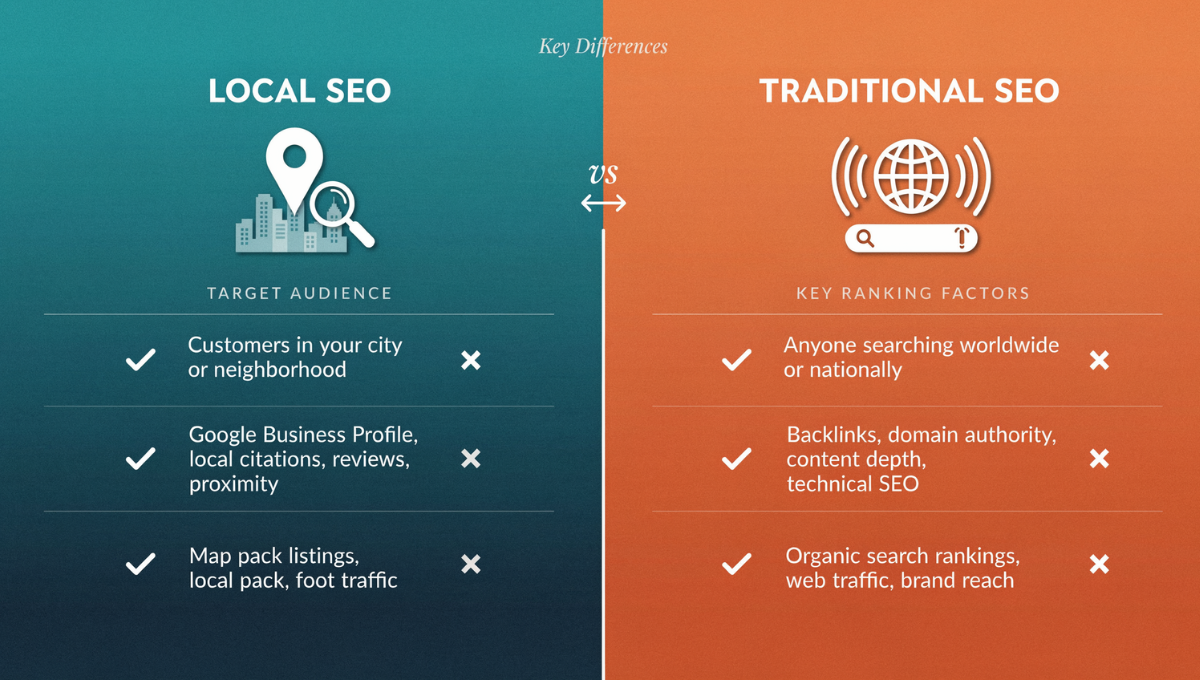
Local SEO improves visibility for location-based searches — Google Maps, the Local Pack, reviews, and business listings. Traditional SEO improves website rankings for broader keywords through content, technical optimization, and authority building.
Local SEO vs Traditional SEO: Quick Comparison
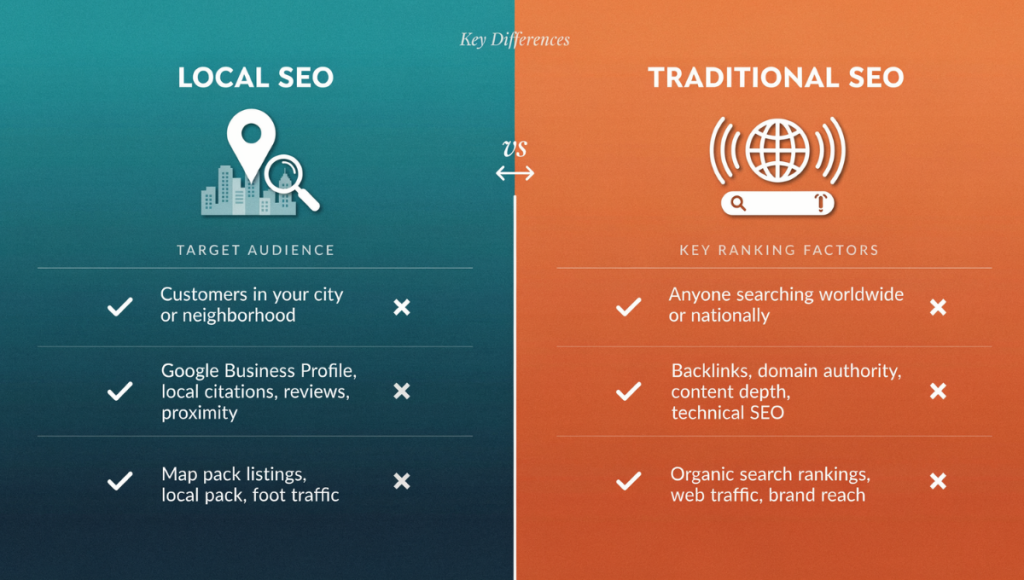
| Factor | Local SEO | Traditional SEO |
| Main Goal | Attract customers in a specific location | Increase visibility across wider searches |
| Target Audience | Local customers | National or global audience |
| Main Platform | Google Business Profile, Maps, Local Pack | Google Search results |
| Keywords | Service + location | Topic-based |
| Key Ranking Factors | Reviews, proximity, citations, local relevance | Content quality, backlinks, technical SEO |
| Best For | Restaurants, clinics, plumbers, local services | E-commerce, SaaS, online businesses |
| Main Conversion | Calls, visits, bookings | Leads, sales, website traffic |
What Is Local SEO?
Local SEO connects businesses with customers searching for products or services in a specific area — think “best dentist near me” or “emergency plumber in London.” These searches carry strong intent: the customer usually wants a business they can contact right away, which is why local SEO matters most for businesses that rely on calls, appointments, or visits.
Google ranks local businesses on relevance, distance, and prominence. Three factors do most of the work:
1.Google Business Profile
A complete profile — correct category, accurate name/address/phone, hours, services, photos, and a website link — helps Google match the business to the right searches. A dental clinic, for example, should list specific services (emergency care, cosmetic dentistry) rather than just “dentist.”
2.Local Keywords
Local keywords add geographic intent: “personal injury lawyer” becomes “personal injury lawyer in Dallas.” Common patterns are service + city, service + near me, and best + service + location.
3.Reviews and NAP Consistency
Review count, average rating, recency, and business responses all signal trustworthiness to both Google and customers. Separately, NAP (Name, Address, Phone) needs to match exactly across the website, directories, and review platforms — inconsistent listings create doubt about which information is correct.
What Is Traditional SEO?
Traditional SEO improves organic rankings for broader, non-location-based searches like “best accounting software” or “how to improve website speed.” These are usually research-stage queries rather than immediate-action ones. Three areas drive results:
1.Content and Search Intent
The best-performing content directly answers what the searcher wants and what problem they’re solving — for example, a project management tool publishing guides on managing remote teams before the reader is ready to buy.
2.Technical SEO
Site speed, mobile usability, internal linking, site architecture, indexing, and schema markup all determine whether good content actually gets found and ranked.
3.Authority Building
Competitive keywords require backlinks, expert content, industry mentions, and brand recognition — a new site competing for “best CRM software” needs real authority signals to break through.
Which Strategy Fits Your Business?
| Business Type | Best Approach | Why |
| Local service businesses (dentists, lawyers, plumbers, restaurants, real estate) | Local SEO | Customers act immediately — calling, booking, or visiting |
| E-commerce | Traditional SEO | Customers compare products nationally, not by location |
| SaaS companies | Traditional SEO | Customers research and compare solutions before signing up |
| Multi-location businesses (e.g., a healthcare chain with clinics in 20 cities) | Both | Local SEO for individual clinic visibility; traditional SEO for national authority and educational content |
Local SEO vs Traditional SEO: How Much It Costs & How Long It Takes?
Local SEO — Investment centers on Google Business Profile optimization, review management, citations, and location pages. Because local competition is often lighter, results can appear faster.
Traditional SEO — Investment centers on content creation, technical improvements, link building, and competitive research. Results typically take longer since building authority requires consistent, ongoing effort.
How to Measure SEO Success: Local SEO vs Traditional SEO KPIs?
One reason businesses get frustrated with SEO is measuring the wrong things. Local SEO and traditional SEO succeed on different metrics.
Local SEO KPIs
- Google Business Profile performance — profile views, search appearances, website clicks, phone calls, direction requests
- Local ranking improvements — Google Maps rankings, Local Pack visibility, location-based keyword positions (e.g., “roof repair Dallas” moving from position 25 to position 3)
- Customer reviews — number of reviews, average rating, review growth rate, response rate
Traditional SEO KPIs
- Organic traffic — visitors from search engines, traffic growth, landing page performance
- Keyword rankings — target keyword positions, ranking improvements, featured snippets, overall search visibility
- Conversion performance — leads generated, sales, form submissions, demo requests, revenue (traffic alone doesn’t grow a business)
FAQ
Is local SEO better than traditional SEO?
Local SEO works better for businesses depending on customers from a specific area (restaurants, clinics, service companies). Traditional SEO works better for businesses targeting broader regional or national audiences.
Can a business use local SEO and traditional SEO together?
Yes — combining both lets a business attract nearby customers now while building long-term search visibility.
How long does local SEO take to show results?
It depends on competition, location, and business reputation. Some improvements appear within a few months; competitive markets take longer.
How long does traditional SEO take?
Usually longer than local SEO, since it requires building content, technical health, and authority over time — often several months in competitive industries.
Do small businesses need traditional SEO?
Many do. Customers often research before buying, so educational content can build trust even for smaller, locally-focused businesses.
Local SEO and traditional SEO solve different problems, not competing ones. If customers need a nearby service, local SEO gets you in front of them when they’re ready to contact a business. If customers research before buying, traditional SEO builds the visibility and trust that earns that decision over time.
Start by answering three questions: Where do your customers search? What problem are they solving? What information helps them choose you? Once you know that, choosing a strategy — or blending both — becomes straightforward.