The common SEO mistakes to avoid are wrong search intent targeting, keyword cannibalization, missing structured data, weak E-E-A-T signals, thin content, poor Core Web Vitals, irrelevant backlinks, weak internal linking, and content that fails to give clear answers for users, Google, featured snippets, and AI search systems.
SEO mistakes do not always look like obvious errors. A website can have clean design, fast hosting, and useful content, but one weak structure can still reduce rankings. Google needs clear intent, strong entities, trusted authorship, helpful answers, and crawlable pages before it can rank content confidently.
This guide explains the most common SEO mistakes to avoid. It covers keyword mistakes, content mistakes, technical SEO mistakes, authority mistakes, and AI search mistakes.
20 common SEO mistakes to avoid:
1. Targeting Keywords Without Matching Search Intent
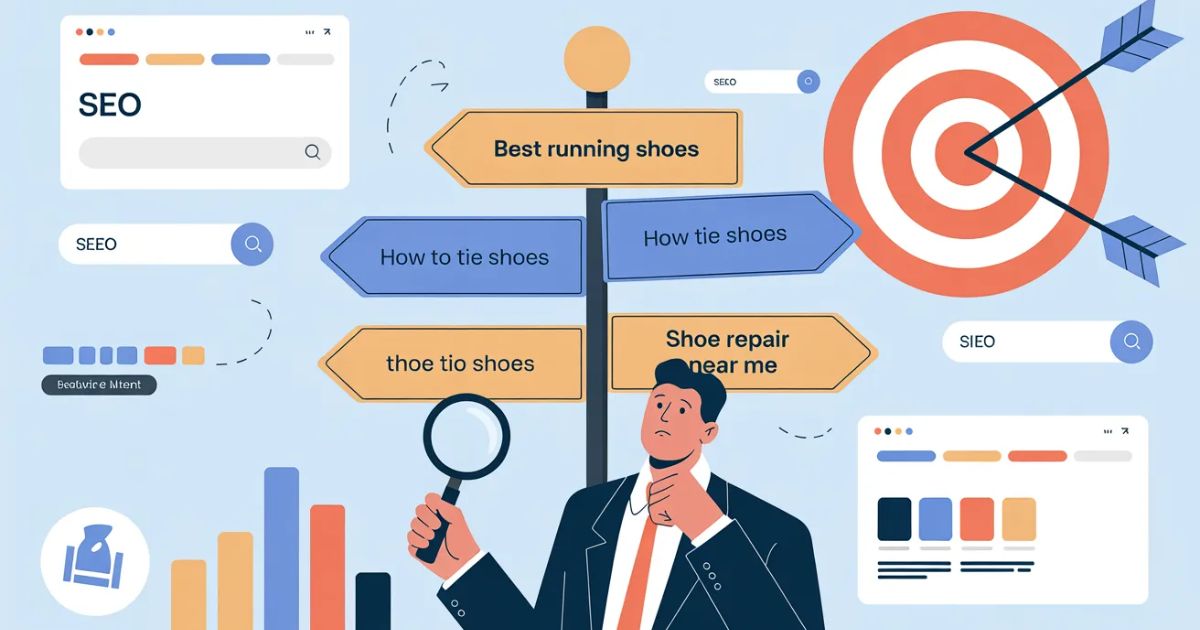
Search intent mismatch happens when a page targets a keyword but fails to match the user’s real goal, expected format, and decision stage. Google ranks pages that satisfy the search intent, so a blog post struggles for a buying keyword, and a product page struggles for an educational keyword.
Search volume does not guarantee traffic. A high-volume keyword becomes useless when the page format does not match the SERP pattern.
A user searching “what is technical SEO” wants an explanation. A user searching “best SEO audit tools” wants comparison content. A user searching “buy SEO audit software” wants a product or pricing page.
Fix: Search the target keyword before writing. Study the top-ranking pages. Match your content format with the format Google already rewards.
2. Creating Keyword Cannibalization
Keyword cannibalization happens when multiple pages on the same website target the same keyword and serve the same search intent. Google receives unclear ranking signals, so the competing pages can split relevance, reduce authority, and create unstable rankings across the same query.
Cannibalization does not mean every similar topic is bad. Cannibalization becomes a problem when two pages answer the same searcher need in almost the same way.
For example, one website may publish “Technical SEO Audit Guide” and “How to Do a Technical SEO Audit.” If both pages target the same intent, Google may rank neither page strongly.
Fix: Merge similar pages, redirect weaker pages, or separate the pages by different search intent.
3. Ignoring Long-Tail Keyword Clusters
Long-tail keyword neglect happens when a website targets only broad keywords and ignores specific search queries with clearer user intent. Long-tail keywords help Google understand topic depth, user problems, buyer readiness, and semantic relationships across a full content cluster.
Broad keywords bring competition. Specific keywords bring clarity.
A broad keyword like “SEO mistakes” has mixed intent. A specific keyword like “common SEO mistakes small businesses should avoid” gives Google a clearer audience and purpose.
Long-tail keywords also support topical authority. A website becomes more relevant when it answers many related questions around one main topic.
Fix: Build content clusters with specific questions, comparison terms, problem-based keywords, and intent-focused subtopics.
4. Publishing Content Without a Unique Angle
Generic content fails when it repeats the same points, examples, and structure that already exist on competing pages. Google needs a clear reason to rank one page above another, so strong content needs original insight, practical examples, expert judgment, or a unique framework.
Accurate content is not always competitive content. A page can be correct and still lose rankings because it adds nothing new.
A unique angle can come from original data, real audit experience, a named framework, a strong opinion, a comparison table, or a case-based explanation.
Fix: Add original examples, expert commentary, practical checklists, real scenarios, or a clear framework that competitors do not provide.
5. Writing for Algorithms Instead of People
Algorithm-first content fails because it uses repeated keywords, generic introductions, padded word counts, and unnatural sentence patterns instead of useful answers. Google rewards pages that solve real user problems with clear language, trustworthy information, and experience-based explanations.
A human reader notices empty writing quickly. Search engines also evaluate usefulness through structure, clarity, engagement, and content satisfaction.
Weak content often starts with a generic definition. Strong content starts with a direct answer. Weak content repeats the target keyword. Strong content explains the relationship between entities, problems, causes, and solutions.
Fix: Write for the user first. Use clear answers, short paragraphs, real examples, and natural language.
6. Using Weak Title Tags
A weak title tag reduces click-through rate because users cannot quickly understand the page topic, value, or relevance. Google uses titles to interpret page context, and users use titles to decide whether one search result deserves the click over another.
A title tag works like a search result headline. It should include the main keyword and a clear value signal.
Weak title: SEO Tips
Strong title: Common SEO Mistakes to Avoid in 2026
The stronger title gives the topic, intent, and time relevance in one line.
Fix: Place the primary keyword near the beginning. Add a number, year, benefit, or specific angle when it improves clarity.
7. Writing Weak Meta Descriptions
A weak meta description reduces search visibility because users cannot understand the benefit of clicking the result. Meta descriptions do not directly guarantee rankings, but they can improve click-through rate when they clearly explain the outcome, topic, and user value.
A meta description should not only say what the page is about. A strong meta description should explain what the user will gain.
Weak meta description: This article discusses SEO mistakes.
Strong meta description: Learn the most common SEO mistakes that hurt rankings, traffic, trust, indexing, and AI search visibility — plus practical fixes for each issue.
Fix: Keep the meta description clear, benefit-driven, and naturally keyword-rich.
8. Ignoring E-E-A-T Signals

E-E-A-T weakness happens when a page lacks visible experience, expertise, author credibility, authority signals, and trust indicators. Google evaluates trust carefully, especially when users need accurate, reliable, and decision-supporting information from the content.
E-E-A-T means Experience, Expertise, Authoritativeness, and Trustworthiness.
A page becomes stronger when it shows who wrote it, why the author understands the topic, when the page was updated, and which examples or sources support the claims.
SEO content needs visible trust signals. A named author, author bio, editorial policy, updated date, internal references, and practical examples all improve credibility.
Fix: Add author details, expert context, update dates, source references, and real experience signals.
9. Publishing Thin Content
Thin content fails when a page does not answer the topic with enough depth, usefulness, or clarity. Thin content is not always short content; thin content is any content that leaves the user needing another page to complete the task.
A 500-word article can be strong when it fully answers a narrow question. A 2,000-word article can still be thin when it repeats generic advice.
Important pages need complete coverage. A strong page should answer the main question, related questions, objections, examples, comparisons, and next steps.
Fix: Add deeper explanations, FAQs, examples, process steps, tables, internal links, and missing subtopics.
10. Keyword Stuffing
Keyword stuffing happens when a page repeats the same keyword unnaturally in headings, body text, anchor text, image alt text, or metadata. Google understands semantic meaning, so excessive repetition can make content look manipulative, robotic, and less useful.
Modern keyword stuffing can look subtle. A page may repeat the same keyword in every heading. A page may use the same internal anchor text again and again. A page may restate the heading in the first sentence without adding new meaning.
Strong semantic SEO uses related entities instead of forced repetition.
For this topic, related entities include search intent, keyword cannibalization, structured data, E-E-A-T, Core Web Vitals, internal links, backlinks, topical authority, indexing, and AI Overviews.
Fix: Use natural keyword variation, entity-rich language, and clear explanations.
11. Failing Core Web Vitals

Poor Core Web Vitals hurt SEO because slow loading, layout shifts, and delayed interaction create a weak user experience. Google uses page experience signals to compare similar pages, especially when competing content has close relevance and quality.
Core Web Vitals measure real user experience.
LCP measures main content loading speed.
CLS measures visual stability.
INP measures interaction responsiveness.
A strong article can still lose users when the page loads slowly or shifts while the user reads. Page experience helps users trust the website and helps search engines evaluate usability.
Fix: Compress images, use WebP or AVIF, reduce heavy scripts, improve hosting, use caching, and limit unnecessary third-party code.
12. Creating Orphan Pages
Orphan pages are pages that exist on a website but receive no internal links from other pages. Google may find orphan pages through sitemaps, but those pages often receive weak authority because internal links do not pass context, relevance, or PageRank to them.
An orphan page can look normal inside the CMS. It can appear in the sitemap. It can even be indexed. But it may still fail to rank because no important page supports it.
Internal links tell Google which pages matter. Internal links also show how one topic connects to another topic.
Fix: Link important orphan pages from relevant blog posts, service pages, category pages, or hub pages.
13. Missing Structured Data
Missing structured data weakens machine understanding because search engines receive less organized information about the page, author, topic, organization, questions, products, or services. Schema markup helps Google connect page content with known entities and rich-result opportunities.
Structured data does not replace strong content. Structured data helps search engines understand strong content with more confidence.
An SEO article can use Article schema, FAQPage schema, Breadcrumb schema, and Organization schema. A service page can use Service schema and LocalBusiness schema when location intent matters.
Fix: Add JSON-LD schema that matches the page type. Validate the markup before publishing.
14. Keeping Broken Internal Links
Broken internal links hurt SEO because they send users and crawlers to missing pages. A broken link also wastes internal authority because link equity points toward a dead URL instead of a useful, crawlable, and relevant destination.
Broken links often appear after redesigns, deleted posts, URL changes, content migrations, or plugin changes.
A few broken links may not destroy performance. Many broken links can weaken crawl efficiency, user experience, and internal authority flow.
Fix: Crawl the website regularly. Update broken links, restore missing pages, or redirect old URLs to the most relevant live pages.
15. Making Robots.txt and Canonical Tag Errors
Robots.txt and canonical tag errors can block Google from crawling, indexing, or ranking important pages. These mistakes create serious SEO problems because search engines may ignore the correct page, choose the wrong URL, or lose access to valuable content.
A robots.txt rule can accidentally block a folder, blog, category, or service section. A canonical tag can point to a staging URL, old URL, duplicate URL, or wrong location page.
These mistakes are dangerous because the page may look perfect to users while search engines receive the wrong technical instruction.
Fix: Check robots.txt, canonical tags, XML sitemaps, indexability, redirects, and URL inspection results after every major website change.
16. Chasing Link Volume Instead of Link Relevance
Irrelevant backlinks fail because Google values link context, topical relevance, editorial quality, and trust more than raw link count. A small number of relevant links can support authority better than many weak links from unrelated websites.
A backlink should make sense in context. A link from a respected SEO website to an SEO guide has topical relevance. A link from an unrelated directory with no editorial value has weak SEO value.
Link quality depends on relevance, placement, traffic, editorial standards, and trust.
Fix: Earn backlinks through original research, expert guides, useful resources, digital PR, industry relationships, and relevant guest contributions.
17. Confusing Domain Authority With Topical Authority
Domain authority confusion happens when website owners focus on third-party authority scores instead of building deep expertise around a specific subject. Google does not need a third-party score to understand whether a website covers a topic thoroughly, consistently, and usefully.
Topical authority comes from connected content.
A strong topic cluster includes one pillar page, supporting pages, clear internal links, related entities, and complete subtopic coverage. A website that covers one topic deeply can outrank a general website with broader but weaker coverage.
Fix: Build topic clusters around subjects where the website already has expertise, relevance, and business value.
18. Not Optimizing for AI Overviews and Answer Engines
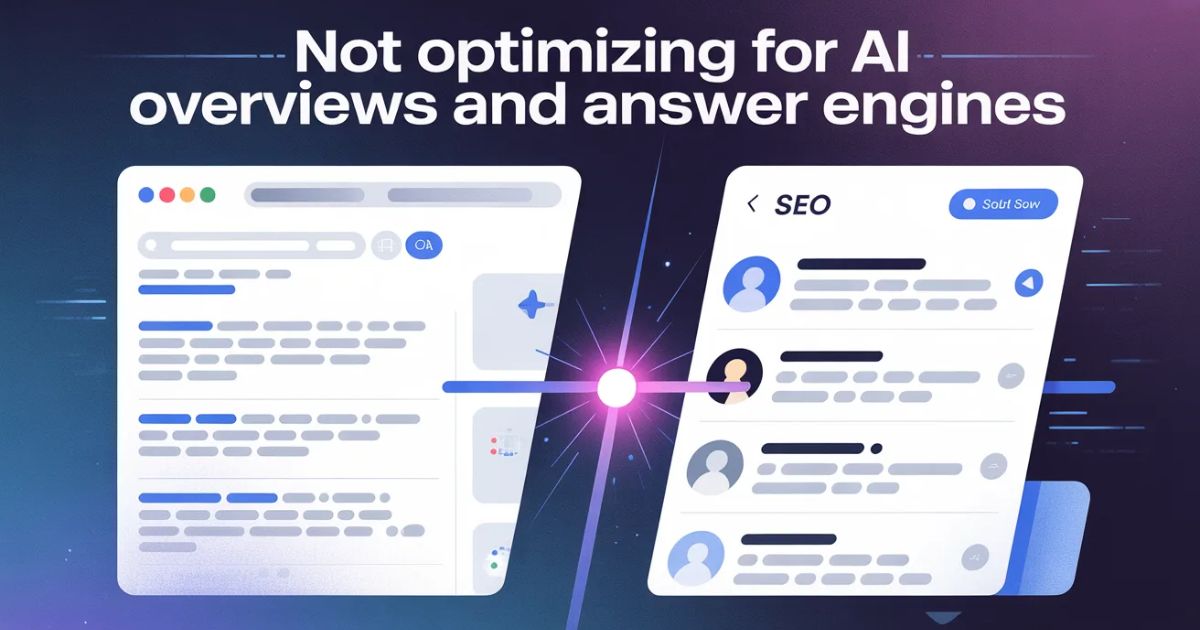
AI search optimization fails when content does not provide clear, extractable, and entity-rich answers. AI systems prefer content with direct answers, clean sentence structure, trusted authorship, FAQ sections, schema markup, and strong relationships between subjects, actions, and objects.
AI systems retrieve information faster when the content is clear.
Weak sentence: It can hurt rankings if done wrong.
Strong sentence: Keyword cannibalization can hurt rankings when multiple pages target the same search intent.
The strong sentence names the subject, action, object, and condition. That structure reduces ambiguity for Google and AI systems.
Fix: Start important sections with a 40–60 word direct answer. Use clear entities, FAQ schema, and simple sentence structure.
19. Publishing AI Content Without Human Editorial Review
Unreviewed AI content fails because it often lacks real experience, original insight, specific examples, expert judgment, and trust signals. AI can support research, outlines, and drafts, but human editors must add accuracy, context, brand voice, and practical value before publishing.
AI-generated writing often sounds clean but generic. It may use vague phrases, repeat common advice, and avoid strong examples.
Human review improves the final content. A human editor should check facts, remove generic wording, add expert examples, improve flow, and align the content with search intent.
Fix: Use AI as an assistant, not as the final publisher. Add human expertise before publishing.
20. Ignoring Zero-Click Search Strategy
Zero-click search becomes a mistake when a website treats every keyword only as a traffic opportunity. Some searches give users answers directly on the results page, so brands must also optimize for visibility, trust, featured snippets, AI citations, and future branded searches.
Not every SEO win creates an immediate click. Some wins create brand memory.
When users repeatedly see a brand in snippets, AI answers, People Also Ask results, and knowledge-style answers, they may search for that brand later. Branded searches can build stronger recognition and trust.
Fix: Optimize important informational queries for SERP visibility, not only direct page visits.
FAQ:
What is the most common SEO mistake?
The most common SEO mistake is targeting keywords without matching search intent. A page cannot rank well when the content format, user goal, and SERP pattern do not match the query that the user enters into Google.
Before writing content, search the keyword manually. Study the top-ranking results. Match the page type, depth, and format with the search intent.
How do I know if my website has SEO mistakes?
A website may have SEO mistakes when important pages get impressions but low clicks, rank outside the top results, fail Core Web Vitals, show indexing issues, contain broken links, or compete against similar pages on the same domain.
Google Search Console can show query, click, indexing, and experience problems. A crawler can show technical, link, and metadata problems.
Can SEO mistakes cause ranking loss?
SEO mistakes can cause ranking loss when they weaken relevance, trust, crawlability, user experience, topical authority, or content clarity. Most SEO mistakes reduce ranking confidence, while manipulative tactics can create stronger search quality problems.
Technical mistakes usually recover faster after crawling. Content quality, trust, and authority problems usually need more time.
How long does SEO recovery take?
SEO recovery time depends on the mistake type. Technical fixes can show improvement after recrawling, content improvements may take several weeks, and authority or E-E-A-T improvements may take several months.
Fast fixes include broken links, robots.txt issues, canonical errors, and missing titles. Slower fixes include thin content, weak authority, and trust gaps.
What tools help find SEO mistakes?
The best tools for finding SEO mistakes are Google Search Console, Screaming Frog, Ahrefs, Semrush, PageSpeed Insights, and schema validation tools. Each tool reveals a different layer of search performance, crawlability, content quality, or authority.
Google Search Console shows search behavior. Screaming Frog shows site structure. PageSpeed Insights shows performance issues. SEO suites show keyword, backlink, and competitor data.
Is keyword stuffing still an SEO mistake?
Keyword stuffing is still an SEO mistake because Google understands meaning, context, and entity relationships better than simple keyword repetition. Repeating the same phrase unnaturally can make content look manipulative, robotic, and less helpful.
The better approach is semantic coverage. Use related terms, clear entities, natural headings, and useful explanations.
The common SEO mistakes to avoid are not only technical errors. The biggest SEO mistakes happen when a page fails to match search intent, build trust, explain entities clearly, support topical authority, satisfy users, and provide extractable answers for modern search engines and AI systems.
Strong SEO needs clear content, useful answers, structured data, trusted authorship, relevant internal links, quality backlinks, fast page experience, and complete topical coverage.